Google just conducted what some are calling a 2:1 stock split, but this really isn't a true stock split. What GOOG has done is created a new class of voting stock and issued one share of these to every stock holder. In effect doubling the number of shares outstanding. But the new non-voting shares are obviously inferior to the original shares.
There are plenty of reasons offered for why firms split their stock - the most common is that there is some sort of desirable trading range that investors want. Firms split to keep their stock prices in this trading range.
But in Google's case I don't think that this is the reason. The reality is that Google's management is seeking to reduce the opportunity for outsiders to gain a controlling stake in the company. In effect Larry and Sergey are taking steps to increase their entrenchment. Their rationale is simple - we know what's best for Google in the long run and those of you who've invested in our company can go and ...(well you get the idea).
Here are a couple of great blog postings on this. First Felix, and then Kid Dynamite.
Google's motto is do no evil. Yeah right.
Showing posts with label corporate finance. Show all posts
Showing posts with label corporate finance. Show all posts
Friday, April 13, 2012


Tuesday, April 10, 2012
Surplus cash, managerial discipline and Instagram
So Facebook just dropped a cool $1 billion for Instagram (the app that turns your 5MP iPhone 4S camera into a crappy 1970s Polaroid). Apart from the fact that posting faded pictures of your dog on Facebook is going to get old pretty soon once everyone does it, there is actually a finance issue here.
Back in 1986, Michael Jensen argued that excessive free cash flow can lead to agency problems where managers use the cash to expand their empires (American Economic Review). This seems to be applicable in this case.
Instagram has no revenue to speak of, although it does have 30 million users (actually 30 million downloads of the app). There are currently 12 people working there (12 very rich people). While it is clear that Instagram must be worth something, $1billion seems a very convenient round number, and a rather high one at that.
When I consider other companies currently worth about a billion dollars: Strayer, Scholastic, Cooper Tire, I am forced to conclude that Facebook overpaid. But I am not surprised. Facebook is a classic case of what Jensen talked about in his seminal paper. The company has a huge amount of cash, it has no need to go to the market (and thus face market discipline), and the CEO has few limits on his decision making. As a result it will continue to burn money like there is no tomorrow.
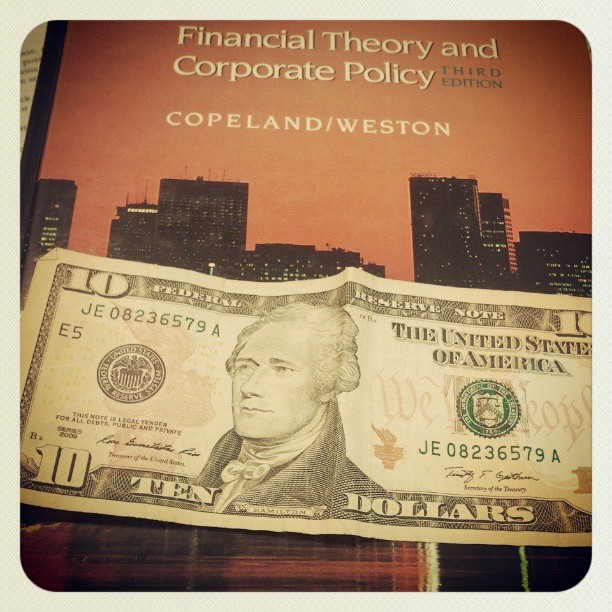
Here's my Instagram tribute to the deal. A $10 bill (1/100,000,000 of the deal) on my copy of the classic corporate finance text that discusses managerial agency issues.

Back in 1986, Michael Jensen argued that excessive free cash flow can lead to agency problems where managers use the cash to expand their empires (American Economic Review). This seems to be applicable in this case.
Instagram has no revenue to speak of, although it does have 30 million users (actually 30 million downloads of the app). There are currently 12 people working there (12 very rich people). While it is clear that Instagram must be worth something, $1billion seems a very convenient round number, and a rather high one at that.
When I consider other companies currently worth about a billion dollars: Strayer, Scholastic, Cooper Tire, I am forced to conclude that Facebook overpaid. But I am not surprised. Facebook is a classic case of what Jensen talked about in his seminal paper. The company has a huge amount of cash, it has no need to go to the market (and thus face market discipline), and the CEO has few limits on his decision making. As a result it will continue to burn money like there is no tomorrow.
Here's my Instagram tribute to the deal. A $10 bill (1/100,000,000 of the deal) on my copy of the classic corporate finance text that discusses managerial agency issues.
Subscribe to:
Posts (Atom)