Dividend cuts are quite rare and even rarer for a stallwart stock like GE. But yesterday, GE cut it's dividend to a penny a share.
https://www.cnbc.com/2018/10/30/general-electric-earnings-q3-2018.html
There wasn't much of a price reaction, the stock had been on a downward trend, but the dividend cut certainly didn't help.
A dividend cut signaled that GE is struggling, but I don't think that was news to anyone. Even an analyst upgrade didn't help the stock price.
https://www.barrons.com/articles/ge-has-problems-but-analyst-sees-upside-for-the-stock-1540998708
A lower dividend payout means that the company can retain more cash and invest in growth, but as basic finance theory would state, dividend policy should be largely irrelevant in firm value.
A Finance Professor's blog. I am a Professor of Finance in the Poole College of Management at NC State University. My website: https://sites.google.com/ncsu.edu/warr Opinions are my own.
Showing posts with label dividends. Show all posts
Wednesday, October 31, 2018
Wednesday, March 6, 2013
Dow Jones - record high?
The "big" news yesterday was that the Dow Jones Industrial Average closed at a record high. While this is an attention grabbing headline - it is actually pretty meaningless.
The Dow Jones Industrial Average is a price weighted index. In short the index is computed by adding up the prices of 30 big stocks and then dividing them by a number called the divisor. As a result, the index only measures changes in prices and is based on a very arbitrary computation.
A better way of measuring the performance of the Dow Jones stocks is the Dow Jones Industrial Total Return Index which includes dividends paid on the stocks.
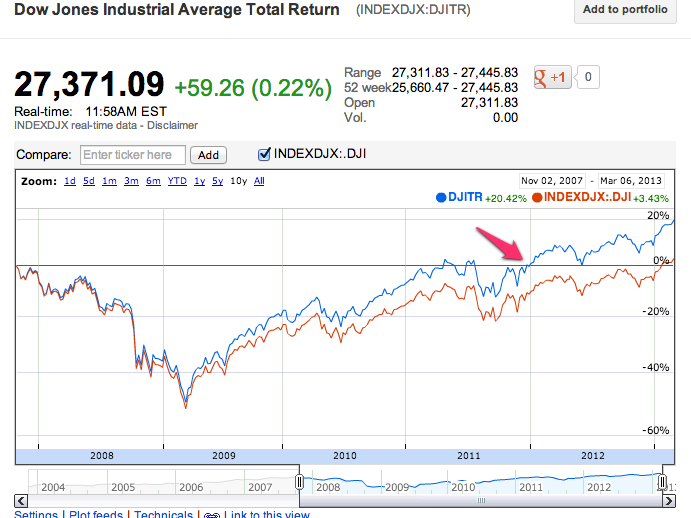
We can see the difference quite clearly:
The blue line is the total return index. I've shown them both from the last record level of the price index which was October 2007. What is clear is that the total return index beat its previous record around the end of 2011. To date it is up 20% since then.
This clearly shows the importance of dividends in computing a return and why just looking at a price index is really pretty pointless.
The Dow Jones Industrial Average is a price weighted index. In short the index is computed by adding up the prices of 30 big stocks and then dividing them by a number called the divisor. As a result, the index only measures changes in prices and is based on a very arbitrary computation.
A better way of measuring the performance of the Dow Jones stocks is the Dow Jones Industrial Total Return Index which includes dividends paid on the stocks.
We can see the difference quite clearly:
The blue line is the total return index. I've shown them both from the last record level of the price index which was October 2007. What is clear is that the total return index beat its previous record around the end of 2011. To date it is up 20% since then.
This clearly shows the importance of dividends in computing a return and why just looking at a price index is really pretty pointless.
Monday, March 19, 2012
Felix opines on Apple's dividend.
Felix Salmon, talks about Apple's dividend. I usually agree with what Felix says - he's a smart, insightful guy, but I think he's off base here on a couple of points.
First he argues that Apple has no control over the level of the dividend yield (D/P) because Apple can't set its stock price. This is plain wrong. Sure, Apple can't control its stock price, but it should at least think about the level of the dividend that it is paying relative to the stock price. Personally, I think that the 1.8% yield is pretty healthy.
Second, Felix doesn't think that the firm should issue debt. He says - what would the firm do with the cash? Well, the firm could buy back stock. As any finance students knows, the firm's cost of capital is based on its WACC. Debt is tax deductible, and for a firm that is so crazy profitable as Apple, any sort of tax deduction would seem like a good idea. This would involve a lot of stock buying back, but so what?
Still an interesting post and worth reading.
First he argues that Apple has no control over the level of the dividend yield (D/P) because Apple can't set its stock price. This is plain wrong. Sure, Apple can't control its stock price, but it should at least think about the level of the dividend that it is paying relative to the stock price. Personally, I think that the 1.8% yield is pretty healthy.
Second, Felix doesn't think that the firm should issue debt. He says - what would the firm do with the cash? Well, the firm could buy back stock. As any finance students knows, the firm's cost of capital is based on its WACC. Debt is tax deductible, and for a firm that is so crazy profitable as Apple, any sort of tax deduction would seem like a good idea. This would involve a lot of stock buying back, but so what?
Still an interesting post and worth reading.
Monday, March 12, 2012
The real Dow index would include dividends and inflation
Because the Dow (and other stock indices) don't account for dividends, it is argued that the "true" level of the Dow should be much higher. Here's an interesting article that shows the effects of dividends and inflation on stock returns.
Tuesday, May 17, 2011
Ken French talks about homemade dividends
Ken French explains the concept of homemade dividends. The basic idea is that you should be indifferent (all else equal) between owning a stock with a 5% dividend yield and a stock with a 0% yield where you sell 5% of your holdings annually.
This is actually a very important concept, and one not well understood by many stockholders. Case in point; the recent concerns of some local shareholders of Progress Energy who have expressed concern about the dividend yield on Progress stock declining after its merger with Duke Energy.
Side note: any students who have taken MBA 521 know this well.
This is actually a very important concept, and one not well understood by many stockholders. Case in point; the recent concerns of some local shareholders of Progress Energy who have expressed concern about the dividend yield on Progress stock declining after its merger with Duke Energy.
Side note: any students who have taken MBA 521 know this well.
Saturday, April 9, 2011
Do dividend paying stocks beat the market?
Reposted from Craig Newmark's blog, an article that claims that dividend paying stocks beat the market. I won't argue with the overall finding. I am sure it is true for the 1993-2007 time period. However, this doesn't mean that it has predictive ability for the future. The article smells strongly of data mining.
In the middle of the study period, the tech bubble burst, resulting in a massive loss in value for tech stocks, who tend to be non-dividend payers.
The moral of the story is that you can pretty much show any trading rule if you pick the right data and the right time period.
As a side note, my students should note that alpha is incorrectly estimated here because the study uses raw and not excess returns.
In the middle of the study period, the tech bubble burst, resulting in a massive loss in value for tech stocks, who tend to be non-dividend payers.
The moral of the story is that you can pretty much show any trading rule if you pick the right data and the right time period.
As a side note, my students should note that alpha is incorrectly estimated here because the study uses raw and not excess returns.
Tuesday, January 25, 2011
Worried Retirees
My local paper, the News and Observer, published a letter from a worried retiree of Progress Energy. For those not following our local news, Progress Energy (NYSE:PGN) is merging with Duke Energy (NYSE:DUK). PGN is located here in Raleigh and so there are many folks in the area who have worked for the company and are now retirees.
The letter expressed concerns as to how the merger would affect the retirees dividend stream from her PGN stock, which was presumably bought as part of some company employee stock ownership plan.
For students of finance, and in particular corporate finance, see if you can spot the major misconceptions held by the letter writer. For bonus points, advise the writer as to whether or not she might want to diversify her portfolio.
The link to the letter is here.
The text is here:
The letter expressed concerns as to how the merger would affect the retirees dividend stream from her PGN stock, which was presumably bought as part of some company employee stock ownership plan.
For students of finance, and in particular corporate finance, see if you can spot the major misconceptions held by the letter writer. For bonus points, advise the writer as to whether or not she might want to diversify her portfolio.
The link to the letter is here.
The text is here:
The Fortune 500 company was once CP&L, and then it became Progress Energy. Now that the company I loved is going to be Duke Energy, I wonder what is in store for the employees - especially for the retired employees.
When I worked at CP&L, the company valued its employees parallel to safety and the bottom line. This change is a major worry. How will Duke treat CP&L's vested retirement plan? What about dividends paid? Will they be paid at Duke's rate or Progress Energy's rate? Will dividends be increased from time to time as before?
Enhancing our stock value by 6.4 percent may be good news for some, but for us who reinvest dividends, the enhanced value is not exciting - we will be buying fewer shares.
I am in shock and saddened that "my company" is being sold. When I joined CP&L, the personnel representative told me if I worked hard and kept my nose clean, I could retire there. I wonder what he would say now.
The buyout, or merger, whichever it is, may be a sound business transaction, but retired employees, who are nostalgic, feel a great loss of connection and of pride, and we are concerned for our future financial security.
Retired CP&L 1994
Wednesday, June 9, 2010
BP's stock price
Felix Salmon has a nice quick discussion of BP and its huge dividend yield.
For my MBA students - this came up in class on Monday night.
Subscribe to:
Posts (Atom)
What's going on with inflation?
I recently posted an article on the Poole College Thought Leadership page titled: " What's going on with inflation?" . This w...
-
There are a lot of similarities between the boom and bust of the Beanie Baby market in the 1990s and booms and busts in financial markets. ...
-
Real options are common in business - they represent the value of being able to choose to do something in the future. An example of a real ...
-
Fama and French answer the age old question: do high beta stocks outperform low beta stock s? Their answer is yes, but not by as much as t...