Cyprus is the latest Euro-zone country to be teetering on the brink of collapse. A key problem facing regulators there is the threat of a bank run. Briefly stated, a bank run can occur when the depositors of a bank all try and withdraw their funds at the same time. In most cases, they choose to do this because there are concerns about the solvency of the bank. However, the mere threat of a bank run can be enough to render a bank insolvent.
Which brings us back to Cyprus. The linked video shows some of the lengths that Cypriot regulators are going to to try to prevent a bank run.
Bank runs are rare - although we saw one a few years ago in the UK.
Showing posts with label banks credit market. Show all posts
Showing posts with label banks credit market. Show all posts
Thursday, March 28, 2013


Monday, October 19, 2009
Smart guys on wall street...
Q. What caused the financial meltdown?
A. Too many smart guys on wall street.
Or so says this entertaining article...
HT: My friend Robert
A. Too many smart guys on wall street.
Or so says this entertaining article...
HT: My friend Robert
Thursday, October 15, 2009
A candid interview with a banker
Excellent stuff courtesy of the Financial Times. 10 minutes long, but pretty entertaining.
Tuesday, September 15, 2009
How did economists get it wrong?
Well, first you have to accept the premise of the title, but assuming that you do (and even if you don't), Paul Krugman has a lengthy article on the evolution of macroeconomics and how it relates to the current situation. I don't know whether I buy it all, but I'm not a macro-economist and I don't have a Nobel prize.
HT: My friend Bill.
HT: My friend Bill.
Did Lehman's collapse start the crisis?
Two very reputable economists from Chicago, John Cochrane and Luigi Zingales suggest that the true cause of the crash probably has more to do with the TARP authorization...as they eloquently state...
HT: Greg Mankiw
In effect, these speeches [about TARP] amounted to "The financial system is about to collapse. We can't tell you why. We need $700 billion. We can't tell you what we're going to do with it." That's a pretty good way to start a financial crisis.
HT: Greg Mankiw
Thursday, September 10, 2009
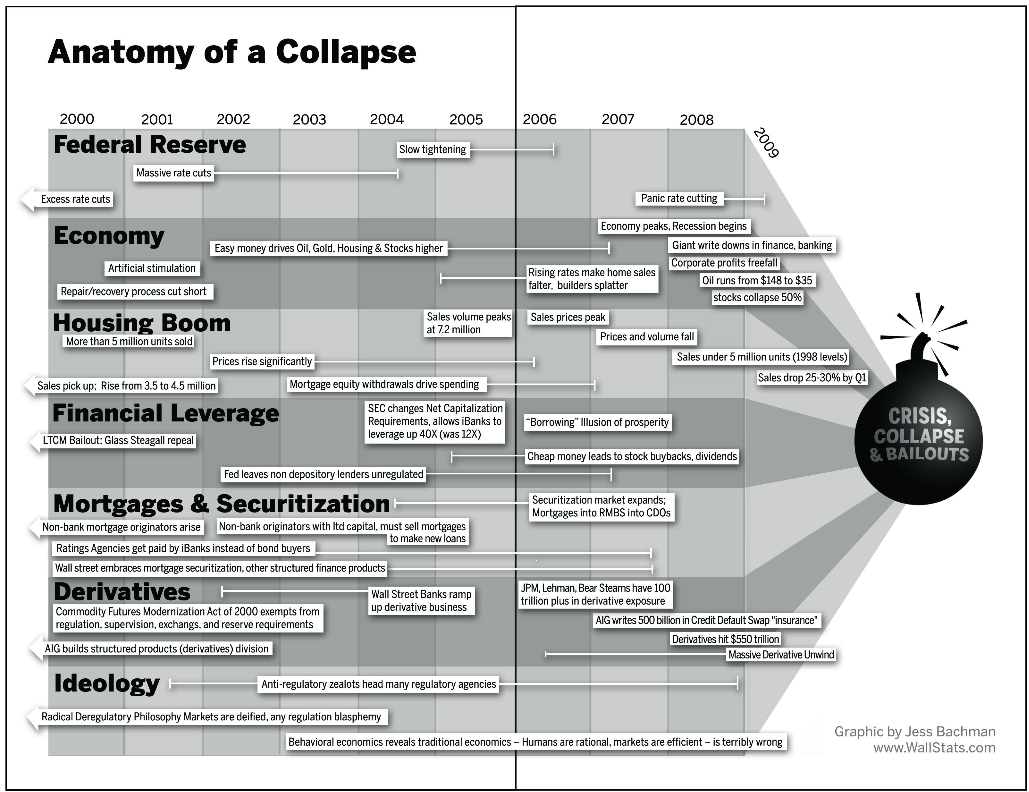
Follow the events that lead to the financial crisis
The BBC has another nice graphic showing a time line of events..
Thursday, August 27, 2009
Socially useless banks?
From the Guardian newspaper... Lord Turner (top financial regulator in the UK) wants to tax "excessive profiteering" by "socially useless banks" in the UK.
All this sounds like a slippery slope to me. What is "excessive" and does he really think that banks are "socially useless"? He also talks about "simplistic regulation". I don't think it was lack of regulation that lead to the particularly bad financial mess in the UK, just bad regulation. In particular, the government took the implicit role of lender of last resort to banks that are too big to fail. Instead, the government should regulate capital standards that are a function of the bank size.
Elsewhere in the article Turner questions whether the financial sector has grown too large. In a free market, capital will move to the the most productive use. In the UK, this turns out to be the financial sector, in part because there isn't much in the way of a significant manufacturing sector anymore. The only way that I could conceive that the financial sector was "too large" is if it is receiving some sort of government subsidy, such as an implicit guarantee. In which case, we know who to blame.
All this sounds like a slippery slope to me. What is "excessive" and does he really think that banks are "socially useless"? He also talks about "simplistic regulation". I don't think it was lack of regulation that lead to the particularly bad financial mess in the UK, just bad regulation. In particular, the government took the implicit role of lender of last resort to banks that are too big to fail. Instead, the government should regulate capital standards that are a function of the bank size.
Elsewhere in the article Turner questions whether the financial sector has grown too large. In a free market, capital will move to the the most productive use. In the UK, this turns out to be the financial sector, in part because there isn't much in the way of a significant manufacturing sector anymore. The only way that I could conceive that the financial sector was "too large" is if it is receiving some sort of government subsidy, such as an implicit guarantee. In which case, we know who to blame.
Monday, July 20, 2009
Robert Shiller on sub primes...
Robert Shiller talks about sub prime mortgages here. He argues that a consumer protection agency should promote plain vanilla debt products for consumers - including sub prime loans. I think this is quite reasonable. In the same way that the junk bond market was hugely successful by financing lower credit quality borrowers, the sub prime loan market can also be successful and fill a gap in the market place. The key is to ensure that those making the loans fully bear the risk of the loans that they are making, and that those taking the loans fully understand the terms.
Felix Salmon disagrees and thinks this is a bad idea. But I think Felix is off the mark here. His criticisms of Shiller's argument are all based on sub prime borrowers getting loans that they couldn't repay. A transparent sub prime market where lenders bear risk would reduce the chance of this happening.
Felix Salmon disagrees and thinks this is a bad idea. But I think Felix is off the mark here. His criticisms of Shiller's argument are all based on sub prime borrowers getting loans that they couldn't repay. A transparent sub prime market where lenders bear risk would reduce the chance of this happening.
Thursday, July 9, 2009
How to deal with foreclosures
The Economist reports on a recent Fed study that tries to explain why so few mortgages that are in default are renegotiated. Turns out, it is not really because of securitization. Instead, banks tend to be reluctant to renegotiate because a) many renegotiated loans end up defaulting anyway and b) some loans that are in default "cure themselves" - in other words - come out of default. So more often than not, not doing anything is the best strategy.
Tuesday, July 7, 2009
Pope calls for new economic system
The Washington Post today reports that the Pope has weighed in on the current financial situation. He bemoans that:
I think the Pope is a little off the mark here. There is actually tremendous social value in an enterprise whose goal is to maximize shareholder wealth. First, millions of us rely on these firms to create wealth for our retirement. Second, maximizing shareholder wealth often results in greater resources being available for charitable work - take the Bill and Melinda Gates foundation for example. Third, the free market system in which capital flows to the most productive use is responsible for the improvement of the lives of millions - through medical advances, technology etc.
I don't think that this is the first time the Pope has been off the mark, but this is a finance blog so we won't go there.
"Without doubt, one of the greatest risks for business is that they are almost exclusively answerable to their investors, thereby limited in their social value."
I think the Pope is a little off the mark here. There is actually tremendous social value in an enterprise whose goal is to maximize shareholder wealth. First, millions of us rely on these firms to create wealth for our retirement. Second, maximizing shareholder wealth often results in greater resources being available for charitable work - take the Bill and Melinda Gates foundation for example. Third, the free market system in which capital flows to the most productive use is responsible for the improvement of the lives of millions - through medical advances, technology etc.
I don't think that this is the first time the Pope has been off the mark, but this is a finance blog so we won't go there.
Monday, July 6, 2009
How maths killed Lehman
A cute article written by an Oxford Ph.D. in Mathematics. (Note to US readers - Maths is the English way of saying "Math".) The article explains nicely how cross-asset-correlation, and the faulty assumption of independence of bad events could be seen as an explanation for Lehman's demise.
The online magazine "Plus - living mathematics" has a few other nice articles related to finance...
What does a financial engineer do?
How to price derivatives
and is Maths to blame?
The online magazine "Plus - living mathematics" has a few other nice articles related to finance...
What does a financial engineer do?
How to price derivatives
and is Maths to blame?
Rolling Stone: Blame Goldman Sachs
I haven't had a chance to wade through this one, but Rolling Stone has a long article on how Goldman has had its fingers in every major bubble in recent history.
Felix Salmon, also reviewed the article and found much to agree with.
Finally, Felix gets a response from GS.
I have to say though that Mr Salmon's stock went down a bit with me after he referred to vegans as "bonkers".
Anyhow, good stuff if you've got some spare time to read it all.
Felix Salmon, also reviewed the article and found much to agree with.
Finally, Felix gets a response from GS.
I have to say though that Mr Salmon's stock went down a bit with me after he referred to vegans as "bonkers".
Anyhow, good stuff if you've got some spare time to read it all.
Tuesday, June 23, 2009
Triple A Punt - Credit Rating Agencies
The Wall Street Journal's opinion page argues that the Obama administration has left the ratings agencies pretty much unscathed in the round of new regulations for the finance industry.
I'm inclined to agree that a lot of the problems that we have faced in the past year or so have been due to a reliance on the three ratings agencies, who occupy a position of government mandated supremacy. Pension funds, endowments and other regulated investment entities like being able to delegate credit screening to these credit agencies - they don't have to do the credit screening themselves.
Now it turns out that S&P is planning to use the CDS market to help set their ratings. In effect they are going to take a clean market signal and repackage it as a noisy, infrequently updated credit rating.
As the CDS market providesan instantaneous market assessment of risk, the role for credit rating companies should be limited - except for the fact that they have a government mandate.
I'm inclined to agree that a lot of the problems that we have faced in the past year or so have been due to a reliance on the three ratings agencies, who occupy a position of government mandated supremacy. Pension funds, endowments and other regulated investment entities like being able to delegate credit screening to these credit agencies - they don't have to do the credit screening themselves.
Now it turns out that S&P is planning to use the CDS market to help set their ratings. In effect they are going to take a clean market signal and repackage it as a noisy, infrequently updated credit rating.
As the CDS market providesan instantaneous market assessment of risk, the role for credit rating companies should be limited - except for the fact that they have a government mandate.
Thursday, June 18, 2009
Thursday, May 28, 2009
Loss contingent capital structure?
An interesting idea here on how bank's capital structure (the amount of debt and equity that they have) should be determined. When the credit default swaps on the banks debt are above a certain level, the bank should be forced to de-lever (i.e. sell equity and buy debt).
Wednesday, May 6, 2009
Friday, March 20, 2009
Did naked shorting bring down Lehman?
Article here on Bloomberg.com argues that naked shorting (shorting without actually borrowing the stock) might have brought down Lehman (or at least contributed to the downfall).
Ordinarily naked shorting shouldn't drive a firm to bankruptcy, unless a depressed stock price weakens the market's confidence in the firm. Clearly that scenario could play out for a highly levered entity like Lehman.
Ordinarily naked shorting shouldn't drive a firm to bankruptcy, unless a depressed stock price weakens the market's confidence in the firm. Clearly that scenario could play out for a highly levered entity like Lehman.
Wednesday, March 18, 2009
Buffet and Moodys
Warren Buffet is rather quiet about the complicity of ratings agencies in the current mess, which is surprising given that he has happily pointed the finger at the other usual suspects.
Could his silence have anything to do with the fact that Berkshire Hathaway owns 20% of Moodys? The NYT takes up the issue.
Could his silence have anything to do with the fact that Berkshire Hathaway owns 20% of Moodys? The NYT takes up the issue.
Tuesday, March 10, 2009
Citigroup makes a profit?
Wow, Citigroup made some money in Jan - Feb of this year. Lets just hope that they aren't making the same mistake as the Beardstown ladies who booked capital injections as profits.
Tuesday, March 3, 2009
Bernanke calls AIG a "hedge fund attached to an insurance company"
Apparently the AIG bailout ticked off Bernanke more than anything else...link here
Subscribe to:
Posts (Atom)