A Finance Professor's blog. I am a Professor of Finance in the Poole College of Management at NC State University. My website: https://sites.google.com/ncsu.edu/warr Opinions are my own.
Friday, January 21, 2022
What's going on with inflation?
Wednesday, June 2, 2021
Inflation is coming and so is inflation illusion.
Inflation illusion is a favorite topic of mine, read prior posts here. It's a topic that comes back time and time again, usually whenever there is a hint of inflation. Case in point - this article in Barrons
The key line: "Both higher yields and inflation itself erode the value of future cash flows, which makes stocks less valuable. "
This is basically inflation illusion - the idea that when bond yields increase, the discount rate for stocks should also increase, thus lowering the value of the cash flows generated by the stocks.
Here's why this is flawed logic:
The value of a firm's equity can be given as: Value=FCFE(1+g)/(R-g)
Where R = the nominal discount rate, FCFE is the free cash flow to equity and g = the nominal growth rate.
When inflation increases, R will increase. This alone will result in a reduction in the value of the stock. However, inflation will also act upon g, the growth rate. Across the economy we would expect, on average for g to increase by the increase in the inflation rate. The net effect of R-g is that the impact of inflation gets cancelled out.
Ironically, the article above contains the line:
"That noise includes supply-chain constraints, which bring the cost of materials higher, incentivizing companies to raise prices."
Monday, June 10, 2019
Why stocks are good hedges for inflation.
Article is here: https://www.wsj.com/articles/which-is-the-better-inflation-hedge-stocks-or-gold-11560132361?mod=searchresults&page=1&pos=8
Quoting from the article:
The reason stocks are a decent inflation hedge is because corporate earnings grow faster when inflation is higher, and grow more slowly when inflation is lower, according to Richard Warr, a finance professor at North Carolina State University. Consider the growth rate of corporate earnings over all 10-year periods since 1871, according to data compiled by Yale University finance professor (and Nobel laureate) Robert Shiller. The volatility of those growth rates was 21% less on an inflation-adjusted basis than it was on a nominal basis, which Prof. Warr says is a good indication of the extent to which equities are able to hedge inflation.To be sure, Prof. Warr adds, higher inflation does reduce the present value of the otherwise higher future earnings. But these two effects should more or less cancel each other out over time.Prof. Warr acknowledges that, over shorter periods of a year or two, stocks often suffer when inflation heats up. His research suggests that is because many investors are guilty of what economists refer to as “inflation illusion.” That is, they focus only on the reduction in the present value of future earnings to which inflation leads, while ignoring the tendency for nominal earnings to grow faster when inflation is higher. So when inflation spikes upward, they sell stocks.Since the inflation illusion is irrational, it is difficult to predict whether investors will be guilty of it the next time inflation heats up. But Prof. Warr says that if they do and their selling causes the stock market to drop, investors should treat it as a buying opportunity."
Tuesday, January 3, 2017
What's the best way to protect against inflation?
http://www.barrons.com/articles/whats-the-best-way-to-protect-against-inflation-1482943455
Thursday, July 11, 2013
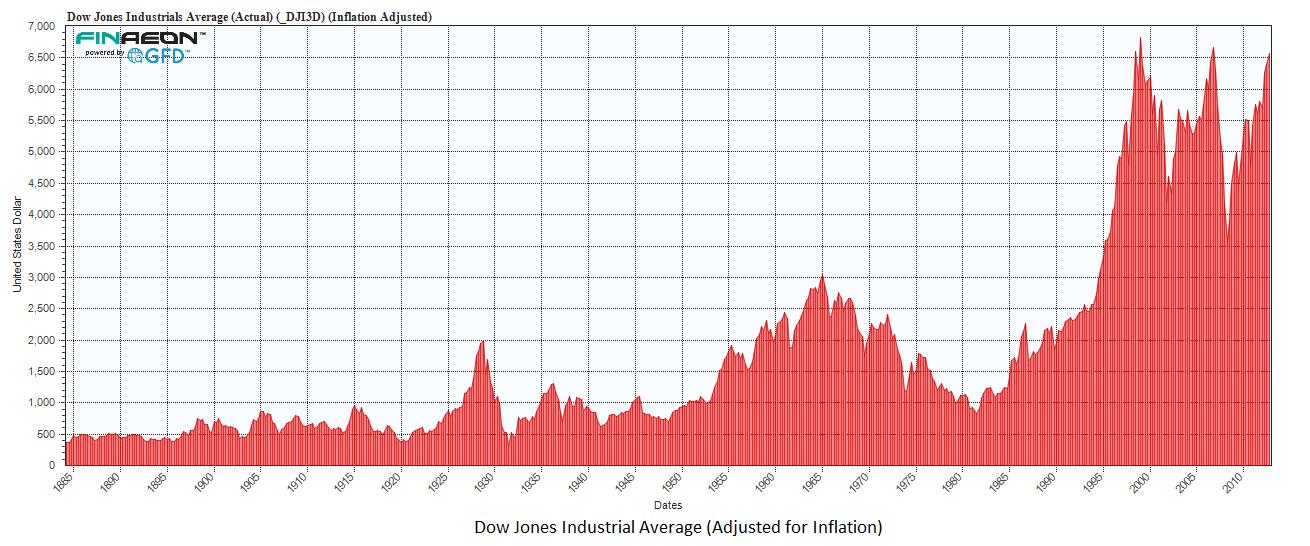
Inflation adjusted Dow
In real terms it appears that we haven't made much real progress in recent years - however I would point out that this chart only shows the level of the index (which is a price index only) and thus ignores the rather healthy dividend yield of about 2.5%. So to say that the Dow has not made real gains against inflation would be a bit of a misstatement.
Wednesday, April 10, 2013
Social security should be indexed to Chained CPI.
Background: We frequently refer to the change in CPI (consumer price index) as being the rate of inflation - but in reality it is merely one way of estimating the rate of inflation. The CPI-U (U refers to urban consumers) measures the price level of a representative basket of goods. The problem with the CPI-U is that it doesn't account for substitutions of one item for another. For example, this week apples are expensive, but bananas are not, so a consumer may switch between the two. If the price index is measuring the cost of living, then it makes sense to include these substitutions. This is what the Chained CPI does.
The President's proposal is to link increases in Social Security benefits to this Chained CPI measure. Because the Chained CPI doesn't increase quite as fast as the non-chained CPI which is currently being used, the net result is that Social Security benefits won't increase as rapidly.
In the short run, there won't be much of a difference, but in the long run the difference will be far more noticeable. Not surprisingly, many advocates for seniors are complaining that this amounts to a reduction in benefits. While technically correct, the fundamental question is what are the benefits that Social Security recipients are entitled to?
As The Economist explains, by indexing Social Security to the ordinary CPI, retirees have, in effect, been getting a real increase in their benefits (note that the word "real" means an increase above the rate of inflation). Even if we were to link Social Security to an index that tracks a basket of expenditures that are more typical of retirees, the rate of increase would still be less.
Given that we're facing an ever increasing federal debt, this seems like a reasonable and fair way of tackling at least part of the problem. It is also worth noting that by not dealing with this problem, the children and grandchildren of today's retirees will most certainly be paying more in taxes and getting less in benefits.
Monday, September 24, 2012
Thursday, September 15, 2011
People just don't understand inflation.
The article is OK overall, but demonstrates a serious misunderstanding of the effect of inflation on stock prices (something that I am particularly interested in). The offending paragraph states that:
To guard against inflation, you can invest in inflation-protected securities or other investments that will gain value as overall prices climb. For instance, stocks in your portfolio aimed at growth rather than income will provide a hedge against inflation, says Michael Reese, Certified Financial Planner and founder of Centennial Wealth Advisory based in Traverse City, MichIt is incorrect that growth stocks (low dividend paying high P/E stocks) will be a better inflation hedge than dividend paying stocks. The value of both stocks derives from the present value of the cash flows generated by the underlying business. Growth stocks reinvest this cash flow, income stocks tend to pay it out. Either way, on average, the cash flow will grow at the rate inflation. Thus the expected return on both types of stock is directly correlated to the expected inflation in the economy. They are both "real" assets and should provide a hedge against inflation.
Sunday, August 14, 2011
The "Fed Model"
The model has been widely discredited by academics because it mixes apples and oranges. Treasuries are nominal assets whereas stocks are real assets (their returns are a function of inflation). The fact that these two series seem to move together doesn't prove that they have predictive ability over the mispricing of stocks compared to bonds. For a great discussion of the Fed Model, see Cliff Asness's article "Fight the Fed Model" I've also discussed this issue in my 2002 JFQA paper with Jay Ritter.
So why bring all this up today? Well, my favorite finance blogger, Felix Salmon appears to be making the Fed Model mistake all over again, long after I thought that the model was dead and buried. Felix doesn't refer to it as the Fed Model directly, but his presumption is that Treasury yields and earnings yields should track each other. After 2002 they don't.
Thursday, February 17, 2011
Inflation linked bonds are back in the spotlight
Alternatives to TIPs include any real asset. For example, in the long run, stocks are excellent inflation hedges, although in the short run they often do poorly, in large part because investors don't understand that they are real and not nominal assets. Commodities are good hedges - but very volatile.
At the end of the day, trying to bet on inflation is a risky business.
Thursday, February 3, 2011
The low real return on inflation linked bonds.
First, a bit of background:
- Siegel is a Wharton Professor who is famous (in the finance world) for his book "Stocks for the long run". Siegel is a strong believer in stocks being excellent long run inflation hedges.
- TIPs are inflation linked bonds that earn a real return plus the rate of inflation. The inflation return is certain - the uncertain part is the real return that you earn.
OK, back to the article. Siegel argues that the low real return on TIPs is due to the low level of economic growth. This makes sense because it is broadly the case that the real rate of interest should roughly equate to the real growth rate. He argues that as the economy improves, real growth will increase and so will the yield on TIPs. Of course, as any student of bond math knows, an increase in rates will result in a drop in the price of the bond. Siegel argues that the drop in the price of TIPs is all but inevitable as the economy improves. His solution is to sell TIPs and buy stocks.
His argument has merits, but moving from TIPs to equities will substantially increase the risk of a portfolio. So while you might dodge an as yet uncertain rate increase on TIPs, you'll expose yourself to much greater market risk. Furthermore, other fixed income securities would come off worse than TIPs as they would be negatively impacted by both real rate increases and inflation rate increases.
Thursday, January 13, 2011
Perceptions about inflation
OK now continue...
The Pew Research Center for People and the Press periodically does surveys to test political and economic knowledge. On a survey done last November, one result really surprised me.
Here are the responses on the inflation question. The percentage chosen is in the left column.
PEW.18 Do you happen to know if the national inflation rate reported by the government is closer
to…
14 1% (Correct)
15 5%
15 10%
7 20%
49 Don’t know/Refused (VOL.)
Basically 85% of those surveyed either had no remote idea of the inflation rate, or thought it was significantly higher. That 35% thought it was 10% or higher is amazing.
Here's a graph of the annual inflation rate. Inflation over 10% is very rare.
Wednesday, November 10, 2010
Is gold at a record high? Actually, no.
Personally, I think there is a gold bubble forming. I predict prices below $1000 in a year.
Tuesday, October 26, 2010
TIPs selling off negative yields
My colleague, Steve Allen expands upon this...
HT: Mike (one of my students)
Friday, August 13, 2010
More on the negative TIPs yield
The great one liner...
In short, the negative TIPS yield is a rational reaction to the lunatic casino that has infested essentially every market in the world.
Wednesday, August 11, 2010
Uh Oh. Negative real TIPs yields...
What does this mean? Well basically investors are happy to park money in TIPs just to keep pace with inflation. They are not actually earning a real return.
Why would investors do this? Perhaps there aren't any better places to put cash right now.
So overall this probably isn't the greatest news...
Monday, March 8, 2010
Inflation Illusion
We’re already months into 2010, and seniors still haven’t seen any relief because of the lack of a cost-of-living adjustment to their Social Security. For the first time in 35 years, the regular payment update they’ve depended on did not occur..
Congress must act quickly. Will you help us flood their offices with letters, demanding that lawmakers make relief a priority?
Presumably, they'd be happier if we had high inflation and they got a larger cost of living increase.
Monday, January 25, 2010
What is a good hedge against inflation?
Fama and French discuss the pros and cons.
Expected inflation
HT: Craig Newmark
Saturday, January 16, 2010
Is high inflation around the corner?
Greg Mankiw makes the same point in his article tomorrow (Sunday) in the New York Times. You can read it here.
What's going on with inflation?
I recently posted an article on the Poole College Thought Leadership page titled: " What's going on with inflation?" . This w...
-
There are a lot of similarities between the boom and bust of the Beanie Baby market in the 1990s and booms and busts in financial markets. ...
-
Real options are common in business - they represent the value of being able to choose to do something in the future. An example of a real ...
-
Fama and French answer the age old question: do high beta stocks outperform low beta stock s? Their answer is yes, but not by as much as t...