Monday, January 10, 2011

Cloud tools for students...

As we start a new semester, here are a few of my favorite online tools for students.  I use all three.

Dropbox
What it is:

  • Free online storage that syncs with a folder on the hard drive of your computers.

Benefits: 

  • You'll never have to back up again.  If you put all your work in to your dropbox folder on your computer it is automatically and instantly synced with the cloud.   
  • If you have dropbox installed on more than one computer, all your work is automatically synced across all your machines.
  • You can share folders with others - which makes it a great tool for online collaboration

What it is:

  • An online storage for pretty much any type of note - whether it be a text note, pdf file, picture from your phone, web clipping, bookmark etc etc.

Benefits:

  • Use it for storing all sorts of data.  
  • Find what you need with the powerful search function that even looks for text in pictures.
  • You can manipulate your notes using a desktop client.

Springpad
What it is:

  • Another online organizer like Evernote but a little different.  
  • Allows you to organize notes by type - bookmarks, products, to do lists, check lists etc.
  • Makes full use of HTML5 - so has a really nice interface.

Benefits:

  • You need a "personal assistant" organizer.
  • You want to create to-do lists that are organized by project and keep the associated project files in the same location
  • You don't care about a desktop client.

I've been an Evernote user for a couple of years, but more recently I've been using Springpad because it's more user friendly for day to day stuff.

Google Reader
What it is:

  • A blog reader for organizing and reading blog postings.


Benefits:

  • It's simple and lightweight.
  • You can access it via your smartphone.
  • You can view this blog on it.

Momentum in stock returns

When a stock that has risen in the past continues to rise, we call it momentum.   Momentum is a bit of a problem for the Efficient Market Hypothesis because it implies a profitable trading rule -  "buy recent winners".

Recent academic studies have found support for momentum effects even after controlling for risk, data mining biases and trading costs.   The Economist has a really nice article on the current state of what we know about momentum.  Well worth a read.

Bogle talks about stocks and bonds

Jack Bogle, creator of Vanguard Funds and devout indexer, talks about returns on stocks and bonds and asset allocation.   The video is on the the Finance Professor blog and is a must see video for all my students.

Jack is forecasting a return on stocks of around 6-7%.  That seems pretty reasonable to me.  If you're using 12% to plan your retirement then good luck.  You'll need it.

Friday, January 7, 2011

Dow vs S&P 500

Considering that the Dow contains only 30 stocks and is a bizarre price weighted index, it does a surprisingly good job of tracking the S&P500.  That is unless if you don't consider the past month or so.  Turns out that the Dow has been lagging the S&P 500 by quite a margin.
Felix Salmon has the details

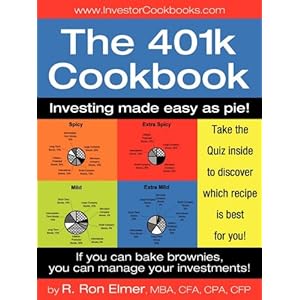
401K Cookbook.

In full disclosure, this is a blatant plug for a friends book, but I highly recommend it to anyone who is trying to figure out what they should do with the funds in their 401K plan.

The 401(k) Cookbook: Investing made easy as pie!

The 401K Cookbook is just that.  A cookbook.   The basic premise is that if you want to make brownies you don't need to know how sugar and flour chemically bond with water and chocolate to create yummy brownies, all you need to know is what proportions to put in the mixing bowl.  The same logic applies to retirement investing.  You don't need to know about portfolio theory, risk premiums, efficient frontiers, you just need to know where to put your money and be done with it.

The 401K Cookbook starts off with a little test that tries to figure out your true investing age.  If you are more risk averse, your investing age will be higher, if you are less risk averse your age will be lower.  You then turn to the page for your investing age and use the allocations that are presented there.  It's that simple.

Once you've created your portfolio, you just need to come back in a year or two and re-take the test and tweak the weights.  The whole process shouldn't take more than a couple of hours.  But if you want to learn more about the logic behind the asset allocations, you can read the back 1/3 of the book which provides a crash course in retirement investing.

Ron Elmer, the author, has a long experience in money management.  He's also a big advocate of indexing.   He saw a need for a simple, straightforward book that people could use to set up their portfolios.  As one didn't exist in the marketplace, he decided to write and publish it himself.

Ron is working on further versions of the book that deal with specific fund companies such as Vanguard and Fidelity.

Malkiel's recommended asset allocation

Burton Malkiel of "a random walk down wall street" fame has updated his recommended asset allocation.  

Seems a bit heavy in Real Estate and emerging markets.

Source: Mankiw's blog

A new year, a new semester and back to blogging.

I took a little break from blogging, but it's time to get back to it.  

As everyone knows by now the most evil investment bank, Goldman Sachs, has taken a private stake in the most evil internet company, Facebook.  All we need now is to find out that Facebook servers run on BP oil and the trifecta will be complete.

So what is GS doing with its newly acquired chunk of FB?  Apparently GS is peddling stakes in FB to some of its favorite customers.  The Wall Street Journal points out that the solicitations look remarkably like the classic Nigerian investment scam emails!

What's going on with inflation?

I recently posted an article on the Poole College Thought Leadership page titled: " What's going on with inflation?" .  This w...