Wednesday, March 6, 2013

Dow Jones - record high?

The "big" news yesterday was that the Dow Jones Industrial Average closed at a record high.  While this is an attention grabbing headline - it is actually pretty meaningless.  

The Dow Jones Industrial Average is a price weighted index.  In short the index is computed by adding up the prices of 30 big stocks and then dividing them by a number called the divisor.   As a result, the index only measures changes in prices and is based on a very arbitrary computation.  

A better way of measuring the performance of the Dow Jones stocks is the Dow Jones Industrial Total Return Index which includes dividends paid on the stocks.

We can see the difference quite clearly:
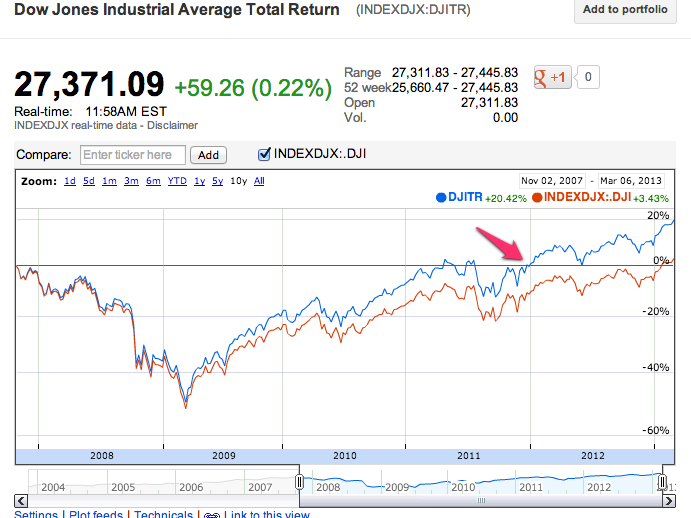


The blue line is the total return index.  I've shown them both from the last record level of the price index which was October 2007.   What is clear is that the total return index beat its previous record around the end of 2011.  To date it is up 20% since then.  

This clearly shows the importance of dividends in computing a return and why just looking at a price index is really pretty pointless.


Saturday, February 9, 2013

Should you add Private Equity to add diversification?

Probably not - from the Economist.

Let's look at a few characteristics of Private Equity.

1. PE has crazy high fees - 2/20.
2. PE underperforms
3. PE has artificially low volatility because its values are assessed by management (not the market).
4. PE is horribly illiquid.

All in all Private Equity sounds awful.  And yet institutional investors line up for it.


HT: Finance II at Tepper.

Wednesday, February 6, 2013

God made a banker

Following on from the "God made a farmer" superbowl ad.  Here's the banker version.

HT: Ron.

Are we still talking about the Fed Model?

Yes, but not in a very nice way.

A great quote:

The fallacy of the model is quite simple. THERE IS NO SUCH THING AS EARNINGS YIELD. The earnings yield is simply the inverse of the P/E ratio whereby corporate earnings are divided by the price of the market. However, as an investor in a stock you do not receive the earnings yield in the form of a cash payment.   However, YOU DO receive the interest yield from bonds.


If you don't know what the Fed Model is - you can check an earlier post on the subject.


Monday, February 4, 2013

Fees at the NC State Pension Fund increase 28%

The investment fees paid to Wall Street firms to manage the state pension fund increased 28% last year.  According to the investorcookbooks blog, currently 27% of all new teacher and state employee contributions go to Wall Street.

To put this in perspective - the current fees are about 40 basis points of the $75 billion under management.  That may not seem like much, but about half the portfolio is managed in house (the fixed income piece) and so these 40 basis points are going to the equity and alternatives which make up the other half of the portfolio.   Simple math implies that the average fee on these assets must be well above 40b.p.   Considering that the fees on institutional equity index funds can be well below 10b.p., these fees seem high.  

Unfortunately, overpaying Wall Street in the hope of beating the market is an affliction suffered by pretty much all state pension funds - which is a shame, because this is an easy way for a state to save a couple of hundred million dollars a year.


What's going on with inflation?

I recently posted an article on the Poole College Thought Leadership page titled: " What's going on with inflation?" .  This w...