Showing posts sorted by relevance for query facebook. Sort by date Show all posts

Saturday, May 19, 2012

Facebook and the Greenshoe option.

On Friday, Facebook's IPO provided us with a fascinating case study on the effects of price support.

Here's the graph of the stock price for the day (note that it didn't start trading right away because of a snafu with Nasdaq's computers).


You'll see that the price basically bottomed out at $38, but never went below $38, which is where the price support kicked in.

With new buyers of the stock trying to sell, the underwriters posted massive buy limit-orders at $38 (a limit order is an order to buy at a specific price).  Known as "price support" in the jargon (or more politically correctly "price stabilization") this is part of the underwriting service which, in exchange for their fee, the underwriters pledge to try to keep the price at or above the initial offer price.  Doing so  ensures that shareholders who bought the stock at the initial offering don't get taken to the cleaners which would be bad for everyone.

You can see the effect of the underwriting support here - where there is a huge block of trades right at $38 and the result of the "epic battle" here.

You might be thinking that the underwriters just got the short end of the stick here - they've had to buy huge amounts of the stock at $38, knowing full well that the stock is likely to go down further on Monday when the market opens again.  But you'd be wrong.   At the end of the Friday, it is unlikely that the underwriters are actually holding any Facebook stock.  

The way the underwriters do this is to use two tricks.  First is the Greenshoe option (named for the company where it was first used, which is now StrideRite).  The Greenshoe, or more technically, over-allotment option lets the underwriter sell 15% more shares than are listed in the offering.  The second trick is that the underwriter is allowed to sell shares that it doesn't own - it can create a naked short position - so in effect, 15% of the shares sold to the public don't actually exist.  (a naked short is when you sell something you don't own, as opposed to a regular short where you first borrow the stock and then sell it.)

So the underwriter has sold 15% extra shares (which don't exist!).   If the price goes up, then the underwriter will exercise the Greenshoe option and get another 15% of real shares from the issuer to cover those naked short shares.  But, if the price falls, as was the case for Facebook, the underwriter will just start buying back shares to cover the naked short.   In theory the underwriter can buy back 15% of all the shares issued,  and at the end of the day have a net position of zero.

The flexibility of being able to take a naked short position combined with the Greenshoe option ensures that the underwriter can provide aggressive price support without actually having to end up owning a ton of stock.

But on Monday it will be a different story.   Once the underwriters have exhausted the 15% that they shorted, they will be unlikely to take one for the team and continue to provide support.   My prediction is that the price will fall, because fundamentally, I don't think Facebook is worth $100 billion.


Tuesday, April 10, 2012

Surplus cash, managerial discipline and Instagram

So Facebook just dropped a cool $1 billion for Instagram (the app that turns your 5MP iPhone 4S camera into a crappy 1970s Polaroid).   Apart from the fact that posting faded pictures of your dog on Facebook is going to get old pretty soon once everyone does it, there is actually a finance issue here.

Back in 1986, Michael Jensen argued that excessive free cash flow can lead to agency problems where managers use the cash to expand their empires (American Economic Review).  This seems to be applicable in this case.

Instagram has no revenue to speak of, although it does have 30 million users (actually 30 million downloads of the app).  There are currently 12 people working there (12 very rich people).  While it is clear that Instagram must be worth something, $1billion seems a very convenient round number, and a rather high one at that.

When I consider other companies currently worth about a billion dollars:  Strayer, Scholastic, Cooper Tire, I am forced to conclude that Facebook overpaid.  But I am not surprised.  Facebook is a classic case of what Jensen talked about in his seminal paper.  The company has a huge amount of cash, it has no need to go to the market (and thus face market discipline), and the CEO has few limits on his decision making.  As a result it will continue to burn money like there is no tomorrow.

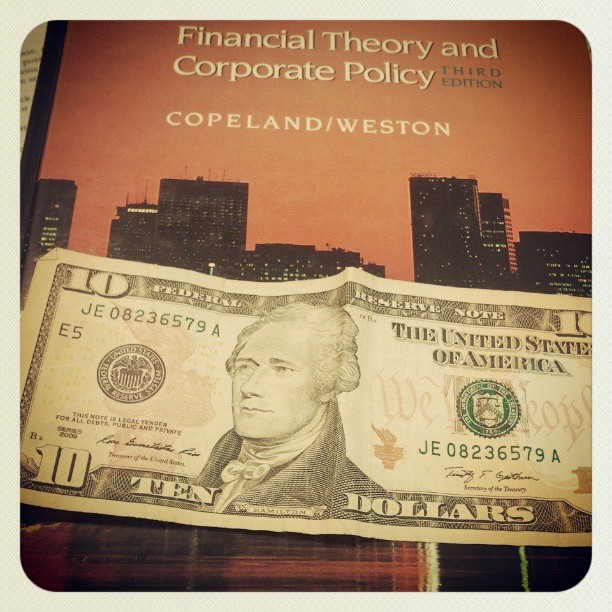
Here's my Instagram tribute to the deal.  A $10 bill (1/100,000,000 of the deal) on my copy of the classic corporate finance text that discusses managerial agency issues.


Monday, January 30, 2012

Facebook's stock symbol

So the question of the day - at least on Twitter, is what should Facebook's stock symbol be when it goes public?  POKE was suggested, but I am guessing something more boring like "FB".

Note that F is already taken by Ford.   An interesting point of comparison, the expected market cap for Facebook is around $100 Billion, and for Ford: around $47 Billion.

Assuming a valuation similar to GOOG, and a PE of 20, Facebook would need to generate around $5 Billion of earnings per year to justify a $100 Billion market cap.


Monday, June 11, 2012

Facebook's growth (or lack thereof).

According to a recent article in the Wall Street Journal, the growth rate of Facebook is slowing quite dramatically.  This is quite normal for large companies - as when they get really big it just becomes a lot harder to grow at a fast rate.  In fact apparently 71% of all internet users in the USA are already on Facebook - so any further growth here either has to come from trying to persuade the other 29% to get on board, or to get the current users to click on more ads.

For Facebook this matters a lot.   FB's PE is around 70 compared to Google's which is around 17.  For FB to have the same valuation as GOOG, it will need to more than quadruple its earnings, or see its stock price drop to single digits.   My guess is that the end result will be somewhere in the middle.

Sunday, March 4, 2012

Elmer for NC Treasurer.

A good friend of mine, Ron Elmer, is running for North Carolina State Treasurer.  Ron's platform is pretty straightforward - he believes that the $75 billion state pension fund should be run by someone with who is an investment expert.  Ron is an experienced money manager, who, like me, believes that the key to amassing wealth is to minimize the fees that are paid to active managers.  This is true for an individual 401K and also for a multi-billion dollar pension fund.

I'm helping Ron with his campaign.  I'll be using my blog to share some of his ideas as we get closer to the primary date in May.  In the meantime, if you like, you can check out his website and also "like" his facebook page.

www.elmerfortreasurer.com
www.facebook.com/elmerfortreasurer

He's also on twitter @relmbo

If you're interested in helping with the campaign - there's an email link on the website - or send him a message in facebook.

Thanks.


As a final note: This blog is my own personal blog and is not endorsed by NCSU.  Blog postings regarding the Elmer for Treasurer campaign are done outside of my work as a Professor at NCSU and are on my own personal time.


Monday, September 24, 2012

Facebook's beta

This link popped up in my RSS reader today - from two different sources - finance II at tepper and newmark's door.

The basic finding:
The return correlation between Facebook and Zinga is greater that the correlation between Facebook and the S&P 500 and the trading volume correlation between FB and the S&P 500 is greater than the volume correlation between FB and Zinga.

I thought I'd run the numbers - here's what  I got:
FB SP500 ZNGA
covar(i,m)0.00001535 0.00007962 (0.00002087)
correl(i,m) 0.04 1.00 (0.04)
var(i) 0.001625 0.000080 0.003155
ann SD (i)
13.962%
3.091%
19.457%
beta (i) 0.19281.0000 (0.2622)
Correl of volume 0.2592 1.00000.3256
R-sqr from CPM
0.18%
0.17%

Obviously these are two stocks that have very low market risk - less that 1% of their returns is explained by the S&P 500.   ZNGA has a negative beta, and the confidence interval for both betas is huge.

In other words, these are two stocks whose risk is virtually all idiosyncratic.  It is probably a mistake to put any weight on these beta estimates.


Friday, August 24, 2012

NC Pension Fund and Facebook.

Unfortunately the State of NC bought a load of Facebook stock at the IPO.  I have no idea why - it seemed to me and to many others that this IPO was overpriced.

Now the State Treasurer is suing Facebook and the underwriters of the stock claiming that they were mislead.

I have a couple of observations on this:

First if the Pension Fund was indexed, we wouldn't have this issue. An indexed portfolio wouldn't be jumping into overpriced IPOs.  I've argued before that indexing this and most pension funds is the way to go.

Second, there are questions being raised about potential conflicts of interest.  I'm in no position to make judgments either way on this, except that I think that more transparency is always the best answer.


Wednesday, May 16, 2012

Is Facebook fairly priced?

So here is my valuation of Facebook.

Based on trailing earnings of $1 billion and an expected market cap of $100 billion we get a trailing PE of 100.

As a comparison, Apple's PE is about 13 and Google's is 19.

It's really not worth spending much more time on this. Facebook is likely to be crazily overpriced.

The next question (as posed to me by my friend Robert) is : "do we short or buy puts?"

Wednesday, February 1, 2012

GRPN LNKD update on the eve of Facebook's filing.

As all finance pundits eagerly await the IPO filing of Facebook, I thought it might be worth just checking in on a couple of the high profile IPOs from 2011 - Groupon (GRPN) and LinkedIn (LNKD).


GRPN -18%.
LNKD -23%.

I'm sure Facebook will do a lot better.

Thursday, February 16, 2012

A Facebook valuation

Aswath Damodaran puts together an excellent valuation of Facebook.

If you're interested in equity valuation and in developing analyst skills, you could do a lot worse than to carefully study Prof Damodaran's work.

Wednesday, May 23, 2012

Even more on the ugly side of Facebook's IPO

A nice article about the under-pricing that usually occurs for IPOs (but didn't occur for FB).  With quotes from my dissertation adviser, Jay Ritter, and another excellent finance researcher, Jacqueline Garner (who's a friend of mine).

Kid Dynamite doesn't feel a whole lot of sympathy for people who participated in the offering...
My expectations for a huge first day pop were already tempered, but I kept my order for two reasons:
1) I was curious as to how retail investors would be treated, given the fact that the Syndicate seemed to be upsizing the deal to satisfy more demand  and
2) I was a greedy pig clinging to the hope that I might get some free money shares – allocated IPO shares that would get a nice first day pop. 
 
And here’s why this IPO was successful:  because all of us greedy, ignorant retail investors who were willing to buy Facebook at any price  STILL had every chance to escape with our hides intact.

And finally, it looks like FB may have behaved quite badly - and possibly violated Reg FD (a rule that prevents management from disclosing material information to only a select few investors).  Joshua Brown has the story.

Monday, January 23, 2012

We're on facebook...

I've started reposting my blog posts on a dedicated facebook page.  Check it out, post a comment or a link and remember to "like" the page!  We'll see how this goes.

Tuesday, May 15, 2012

Facebook IPO - yawn...

In case you've been living under a rock, Facebook's IPO is scheduled for Friday.   As Felix Salmon notes, there has been much talk about whether you should buy some of the stock.

Let's be clear here.  For individual investors, it will near impossible to buy the IPO at the issue price.  But to buy the IPO at the post issue price (once it begins trading) is a bad idea.   History shows that on average, IPOs purchased on the first trading day significantly underperform similar stocks in the long run.

Just stick to indexing.

I've posted a lot on this before - here

Friday, January 7, 2011

A new year, a new semester and back to blogging.

I took a little break from blogging, but it's time to get back to it.  

As everyone knows by now the most evil investment bank, Goldman Sachs, has taken a private stake in the most evil internet company, Facebook.  All we need now is to find out that Facebook servers run on BP oil and the trifecta will be complete.

So what is GS doing with its newly acquired chunk of FB?  Apparently GS is peddling stakes in FB to some of its favorite customers.  The Wall Street Journal points out that the solicitations look remarkably like the classic Nigerian investment scam emails!

Wednesday, February 1, 2012

A Facebook IPO explainer.

Everything you wanted to know about Facebook's IPO in a nice easy to read format.

Nicely done.

(edited to put in correct link)

Thursday, February 20, 2014

Facebook's purchase of Whatsapp...

A couple of divergent opinions on the latest shopping spree from Facebook.

Felix Salmon:
Zuckerberg will dominate the mobile market at any cost because he has almost bottomless pockets.


Kid Dynamite:
This looks like an April Fool's day deal.  FB has paid through the nose for people who by definition use Whatsapp because it is basically free.  It's Groupon all over.

Me:
I've given up trying to figure out whether what FB does makes any sense.  I note that as of today, the price of FB is trading close to $70.   My earlier prognostications about the stock being overvalued at IPO were wrong.   This is why I index - I am a useless stock picker, but to my credit, I know this.

Monday, May 21, 2012

Facebook - the hangover.

As I said on Friday, Facebook was going to trade below $38 today (Monday), sure enough:


This is probably the first, and last time that I will correctly call a stock price movement.

Thursday, February 2, 2012

The Facebook halo effect...

OK I didn't see this one coming ... LNKD spikes up on Facebook's IPO filing.


Tuesday, March 20, 2012

Facebook paying 1.1% underwriting fee

Apparently Facebook has cut a sweet deal on underwriting services for its upcoming IPO and is only paying 1.1%.  This is in contrast to the typical fee which is around 7%.[link to a pdf].

HT: Thomas (a student in the Advance Analytics program at NCSU).

Tuesday, September 28, 2010

Multi tasking, interruptions and team building.

A little non-finance, but it is related to study and work habits.

Clifford Nass, Stanford Professor, explains why team building doesn't work and why multi tasking is bad.


The multi tasking bit is especially relevant.  Answer this question.  When you are supposed to be working, are you receiving text messages, emails, facebook updates etc?   Are any of these things so important that you HAVE to read them immediately?

I realized that I have my email set to check for new messages pretty frequently.  I also get a little popup notification on the screen.  But this is crazy - I've configured my computer to interrupt me when I am presumably doing something useful.

As for the part on team building.  I've only been on team building exercises twice and I thought it was a complete and utter waste of time.  I now feel vindicated.

What's going on with inflation?

I recently posted an article on the Poole College Thought Leadership page titled: " What's going on with inflation?" .  This w...